

Profiled Fillers
Profiled foam fillers close the gaps between roofing or cladding sheets and adjoining flashings. Cut to follow the sheet shape, they form part of the closure detail at eaves, ridges and other roof and wall junctions.
Large Flute & Small Flute Fillers
Large flute and small flute fillers fit opposite faces of a profiled sheet. In a typical roof arrangement, large flute fillers sit above the sheet beneath the ridge flashing, while small flute fillers fit beneath the sheet at the eaves.
The correct choice depends on the sheet profile and which way it is fitted. Reverse profiles can change the filler required above or beneath the sheet, so the actual sheet shape and orientation matter more than the ridge or eaves description alone.
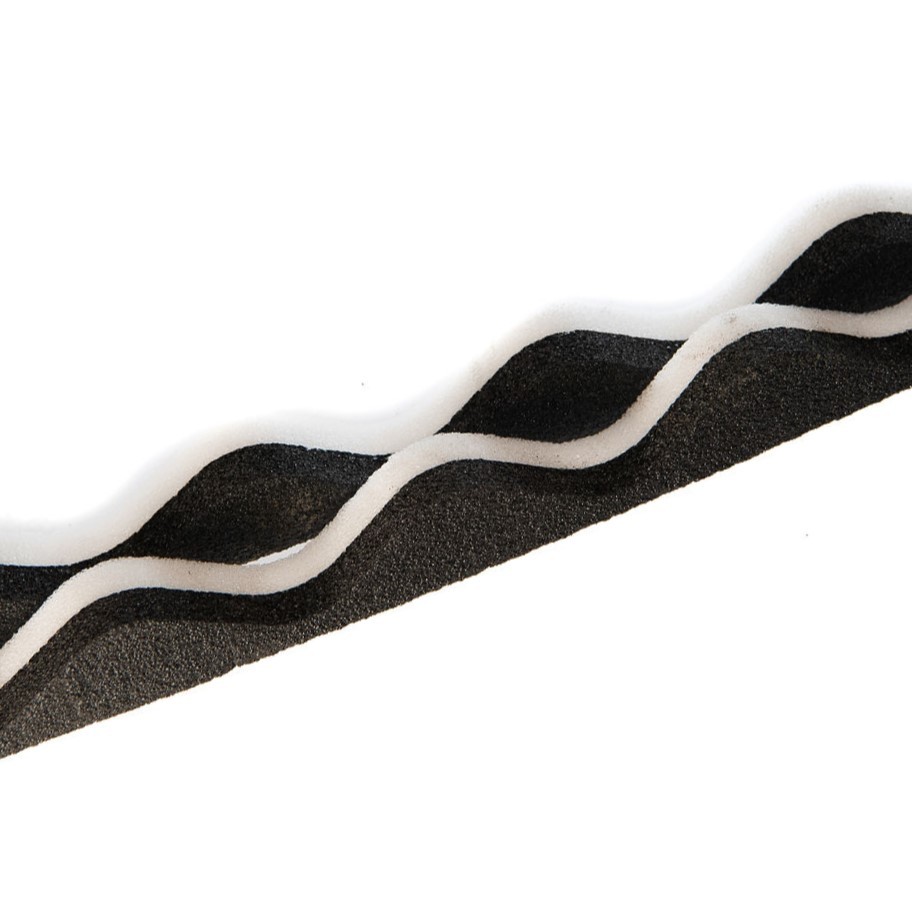
Filler Options
Profile & Dimensions
The filler must match the complete sheet profile, including the rib spacing, depth, crown and pan widths, and any smaller ribs. Sheets with the same depth or cover width can have different shapes. The manufacturer and full profile reference, or a dimensioned section drawing, help establish the correct match.
Base height, filler thickness and strip length are separate dimensions. The base is the continuous band beneath the shaped profile. Thickness runs along the sheet ribs, while strip length runs across them.
Materials & Sealing
Closed cell polyethylene foam is commonly used for profiled fillers. The material and grade should suit the exposure and compression required at the junction. Foam fillers close profile gaps; they do not provide structural support for the sheets.
Plain fillers have no factory applied adhesive. Adhesive facings help hold the filler in position, while a specified sealant facing forms part of the joint seal. Depending on the product, these can be applied to the shaped face, straight base or both.
A self adhesive face alone does not establish a weather seal. The filler must fit correctly, with surface preparation, bedding sealant and compression following the selected roof or wall detail.
Angled Fillers
Angled fillers follow junctions that cross the sheet ribs diagonally, such as hips and valleys. Their shape must account for both the roof pitch and the angle of the junction when viewed from above.
Left and right handed arrangements differ, so the cut must also suit the side and orientation of the junction.
Ventilation & Drainage
Some roof and wall details require airflow or drainage through the closure. Where this applies, the filler arrangement must preserve those paths rather than close every opening.
Use the ventilation or drainage detail specified for the construction, keeping the required openings clear of fillers, tapes and sealants.